
Interpretation of progesterone test results
About us > Our breeding
ARTICLES
To access the article click on the title
Hormonal Fluctuations in the Estrous Cycle of the Bitch
Hormonal fluctuations during the estrous cycle of the bitch are key to determining ovulation and, consequently, the period of peak fertility. The two most useful hormones for this purpose are progesterone and luteinizing hormone (LH).
Luteinizing Hormone (LH)
Throughout the cycle, LH levels remain basal until a surge occurs approximately 48 hours before ovulation. Identifying this LH surge in the blood allows for precise prediction of ovulation. However, this hormonal peak is brief, and the half-life of LH in the blood is very short. This means blood samples would need to be collected twice daily to ensure detection of the peak, which significantly increases the cost and inconvenience for both the animal and the owner. As a result, the use of LH testing is generally reserved for very specific cases.
Progesterone
The second hormone with predictive value is progesterone. Its rise from basal levels (below 1 ng/mL) to levels exceeding 10 ng/mL helps identify the optimal timing for natural mating or artificial insemination. Progesterone measurement is performed serially, as a single value is often insufficient for monitoring. Multiple samples are usually required to create a hormonal curve.
Vaginal cytology is commonly used to monitor estrus, and progesterone measurements are initiated when 60–70% of vaginal epithelial cells appear flat or keratinized. Blood samples are typically taken every 24–48 hours, depending on the type of analysis performed.
Methods for Measuring Progesterone
There are two main techniques for assessing progesterone levels in the blood:
1. Radioimmunoassay (RIA)
- Advantages:
- The most accurate method, providing precise numerical values (quantitative results).
- Highly reliable analytical technique.
- Disadvantages:
- Expensive and complex to perform.
- Limited availability in some areas.
- Laboratory turnaround times can delay results.
- Often used retrospectively in cases where pregnancy was not achieved. Serum samples can be frozen and sent later to create a precise hormonal curve, helping to identify potential errors.
2. Enzyme Immunoassay (ELISA)
- Advantages:
- More affordable and readily available.
- Rapid results, making it suitable for use in most veterinary clinics.
- Can be quantitative (more precise, available in laboratories) or semi-quantitative (kits providing results in progesterone ranges based on color perception).
- Disadvantages:
- Less precise than RIA.
- Results can be influenced by factors such as ambient temperature and sample quality (e.g., hemolysis).
- More effective at detecting very high or very low values.
Timing of Ovulation and Fertility
Ovulation is triggered by the luteinizing hormone (LH) surge, designated as day 0. Ovulation occurs two days after this LH peak. Following ovulation, oocytes require 2–3 days to mature, and the mature eggs remain viable for 48–72 hours.
Thus, the peak fertility period for the bitch occurs on days 5 and 6 after the LH surge, or approximately days 3 and 4 post-ovulation. The rise in progesterone levels corresponds closely with the LH surge, allowing progesterone monitoring to provide a relatively accurate estimate of ovulation timing.
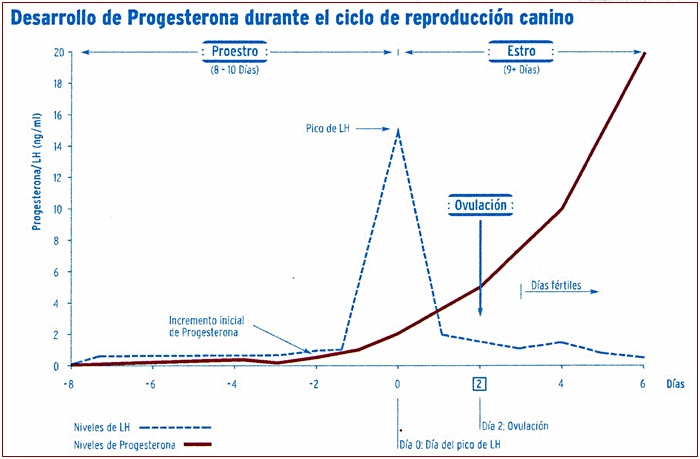
According to the data, progesterone levels are low before ovulation (between 0 and 1 ng/mL). When progesterone begins to rise, the LH surge occurs (day 0). Progesterone levels continue to increase in the following days. Pregnancy is only possible if the oocytes are mature (2 days after ovulation) and the sperm are viable (5 ± 2 days).
In 20% of bitches, ovulation occurs outside the typical window of days 10 to 14 from the onset of estrus. Additionally, 20% of bitches ovulate with atypical progesterone levels: some ovulate earlier with progesterone levels of 1–2 ng/mL, while others ovulate later with levels exceeding 10 ng/mL. These are exceptions to the general rule but are not rare occurrences; they are simply less frequent and can only be identified when the general guideline does not apply.
Interpretation for Determining the Optimal Time for Insemination
| <1 ng/ml | Basal blood progesterone concentration. Anestrus or early pro-estrus. If it is early pro-estrus, perform cytology and re-analyze progesterone when obvious signs of the end of pro-estrus or early estrus are observed. |
| 1-4 ng/ml | Pre-ovulatory progesterone increases. The LH peak is usually observed when progesterone is 2 ng/ml or when progesterone has increased from previous values. |
| 4-8 ng/ml | Around ovulation. |
| 6 - 10 ng/ml | Period at the end of oocyte maturation, expulsion of polar bodies and beginning of oocyte receptivity. |
| > 12 ng/ml | The bitch is fertile; the time of AI or mating is determined by the type of semen used (fresh, chilled or frozen), according to the number and type of inseminations. The second service will be carried out 24 or 48 hours after the first, depending on the type of semen used (fresh, chilled, frozen). |
| > 20 ng/ml | In many bitches the cervix closes and vaginal AI will not be successful. In these cases transcervical AI can be applied. |
Interpretation in Pregnant Bitches
| 2 ng/ml | Minimum progesterone level necessary to maintain pregnancy. |
| < 2 ng/ml | Progesterone drops below 2 ng/ml 12 to 48 hours before the onset of labor. If progesterone is < 2 ng/ml and there are no obvious signs of labor, the need for a cesarean section should be considered. |
Vaginal cytology, vaginoscopy, and progesterone level testing complement each other and, when applied dynamically through serial repetition, form an excellent tool for ensuring success in canine reproduction. These techniques are not recommended as standalone methods or when performed in a non-dynamic, single-application manner.
OUR PERSONAL EXPERIENCE
The measurement of serum progesterone levels to determine the moment of ovulation is useful not only to identify the optimal time for mating but also to accurately predict the whelping date. Normally, whelping occurs between days 62–64 post-ovulation. Based on our experience, Mastiffs tend to whelp on day 63, while Jack Russell females generally deliver a day earlier, around day 62 post-ovulation. So far, we have only had one case outside these parameters: a Jack Russell female that whelped on day 61. Thus, we conclude that this method is highly reliable.
In cases where the litter size is very small—only one or two puppies—it may be necessary to schedule a cesarean section, and knowing the exact whelping date can be very helpful. If progesterone levels have not been measured, we can wait for the first signs of labor to perform the cesarean, but this poses the risk of it occurring at night, necessitating emergency services. It is also important to note that in giant breeds, small litters of just one or two puppies frequently fail to initiate natural labor. When we consult the veterinarian to investigate why the female has not yet delivered, it may already be too late, and the puppies could have died.
It is also worth mentioning that progesterone values may vary depending on the laboratory conducting the test. This should be taken into account, and it is advisable to contact other breeders using the same laboratory to compare experiences. Additionally, consistently using the same laboratory ensures more reliable references based on one’s own data.
We have been working with the same laboratory for eight years and have observed that their results tend to be slightly below normal reference ranges. Jack Russell females ovulate at levels between 4–6 ng/ml, which is somewhat lower than the attached charts suggest, while Pyrenean Mastiff females ovulate at slightly lower levels, between 3–5 ng/ml. This discrepancy in Mastiffs can be attributed to the fact that the test measures serum progesterone levels, and giant breeds have a significantly larger blood volume, resulting in slower dilution. It is essential to remember that once progesterone levels begin to rise, the process progresses rapidly (as a general rule, values approximately double each day; for example, if today the female has 3 ng/ml, tomorrow she will have 6 ng/ml, and the day after, 12 ng/ml).
Insemination Schedule
We follow these guidelines for insemination (considering day 0 as the day of ovulation):
In cases where the litter size is very small—only one or two puppies—it may be necessary to schedule a cesarean section, and knowing the exact whelping date can be very helpful. If progesterone levels have not been measured, we can wait for the first signs of labor to perform the cesarean, but this poses the risk of it occurring at night, necessitating emergency services. It is also important to note that in giant breeds, small litters of just one or two puppies frequently fail to initiate natural labor. When we consult the veterinarian to investigate why the female has not yet delivered, it may already be too late, and the puppies could have died.
It is also worth mentioning that progesterone values may vary depending on the laboratory conducting the test. This should be taken into account, and it is advisable to contact other breeders using the same laboratory to compare experiences. Additionally, consistently using the same laboratory ensures more reliable references based on one’s own data.
We have been working with the same laboratory for eight years and have observed that their results tend to be slightly below normal reference ranges. Jack Russell females ovulate at levels between 4–6 ng/ml, which is somewhat lower than the attached charts suggest, while Pyrenean Mastiff females ovulate at slightly lower levels, between 3–5 ng/ml. This discrepancy in Mastiffs can be attributed to the fact that the test measures serum progesterone levels, and giant breeds have a significantly larger blood volume, resulting in slower dilution. It is essential to remember that once progesterone levels begin to rise, the process progresses rapidly (as a general rule, values approximately double each day; for example, if today the female has 3 ng/ml, tomorrow she will have 6 ng/ml, and the day after, 12 ng/ml).
Insemination Schedule
We follow these guidelines for insemination (considering day 0 as the day of ovulation):
- When using a local male or one nearby, allowing for three inseminations: Perform inseminations on days 1, 3, and 5 post-ovulation.
- When using a male from another location, allowing for only two inseminations: Perform inseminations on days 2 and 4 post-ovulation.
- When using chilled semen and only one insemination is possible: Perform insemination on day 3 post-ovulation.
OTHER USES OF THE PROGESTERONE TEST
When we perform an ultrasound on a female to determine if she is pregnant (from day 21 post ovulation the embryonic sacs can already be seen) we may find that there are hardly any live embryos but several embryos are in the process of reabsorption. In this case it is important to perform a progesterone test because if the level is very close to 2 ng/ml we are dealing with a case of hypoluteoidism and, to maintain pregnancy (if there are any live embryos), it would be necessary to supplement with progesterone. To maintain pregnancy, progesterone should be supplemented with serum progesterone values below 5 ng/ml.