
Canine herpesvirus
About us > Our breeding
ARTICLES
To access the article click on the title
Introduction
Canine herpesvirus (CHV) infection is a condition primarily observed in breeding populations, such as kennels. This disease is of significant concern to breeders because it markedly reduces reproductive success and can lead to severe losses among neonatal puppies. While CHV may cause mild illness when acting as a sole agent, it can result in severe complications when combined with other infectious agents and can also affect adult dogs.
Canine herpesvirus can impact female fertility and fecundity, leading to a range of reproductive issues. The infection may cause embryonic resorption, failure to conceive, abortion, or reduced litter sizes. In some cases, puppies die shortly after birth. However, CHV infections in adult dogs are often subclinical, and the condition frequently goes undiagnosed.
Incidence
In some kennels, over 90% of dogs are seropositive for CHV. Additionally, in 48% of kennels experiencing reproductive issues, more than 50% of the dogs are seropositive. Moreover, in 67.6% of kennels where over 50% of dogs are seropositive, reproductive problems are reported.
It is important to note that these figures may underestimate the true spread of the virus. Epidemiological studies primarily rely on serology, but CHV is weakly immunogenic, meaning that detectable antibody levels do not persist beyond two months. As a result, serology only identifies animals with recent exposure to the virus or those experiencing viral reactivation. Many latently infected animals likely evade detection.
Individual Scale Serology
Serology performed at a single time point does not allow for unequivocal characterization of the infection status. However, establishing a group profile based on serology can serve as a useful tool for diagnosis, prognosis, and advising kennels.
In 2000, a serological study was conducted in Spain to evaluate the serological prevalence of canine herpesvirus (CHV) in kennels actively engaged in breeding. The selection of kennels was guided by the voluntary choice of a group of veterinary reproduction specialists. A total of 16 kennels were included, and a stratified study was performed based on the physiological status of groups with more than 10 individuals. The analysis included 115 animals (young dogs, active males, females in anestrus, pregnant females, and retired breeders). The titration technique employed was ELISA, with a positivity threshold set at 0.5.
The seropositive rate was 74.8% (86/115) across all animals tested. Only one kennel was completely negative (1/16), but more than a third of the kennels (7/16) had an average titer that did not exceed 1.0. The frequency of seropositive animals was greater than 75% in most kennels (11/16). The size of the kennel did not influence the average titer or the frequency of seropositivity. Retired breeders and males appeared to be the most affected physiological categories.
The epidemiological situation in the sample of Spanish kennels analyzed differs significantly from a larger sample of 87 randomly selected French kennels analyzed during the same period. This discrepancy could indicate a higher prevalence in Spain, although it cannot be ruled out that some kennels participated in the study due to reproductive failures.
Etiology
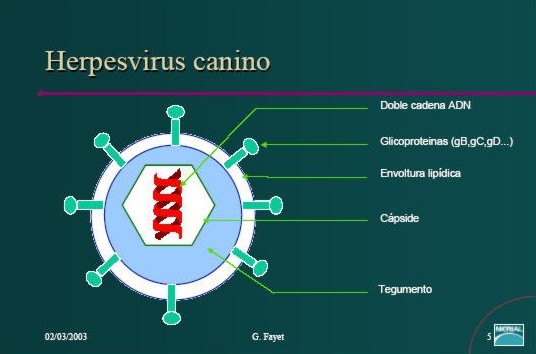
The causative agent is canine herpesvirus type 1 (CHV-1), an alpha herpesvirus similar to herpes simplex and varicella-zoster virus in humans, feline herpesvirus, equine herpesvirus, Aujeszky's disease virus, and infectious bovine rhinotracheitis virus in mammals, as well as Marek's disease virus in birds. These viruses lose infectivity rapidly in the environment and are easily destroyed by heat, ultraviolet light, lipid solvents (chloroform, ether), and most disinfectants (quaternary ammonium, phenols, formaldehyde).
In contrast, herpesviruses are characterized by rapid replication in cell cultures (less than 24 hours) with lysis of infected cells. The optimal temperature for CHV incubation in cell culture (which exclusively grows in canine cells) is 35–36°C, corresponding to the body temperature of neonatal puppies and the "cold" mucosal surfaces of adult dogs, such as genital, respiratory, and ocular mucosa. Higher temperatures inhibit viral replication, which is significant for both the pathogenesis and treatment of the disease.
CHV can survive in the external environment for about 24 hours, depending on temperature and relative humidity. It is stable at a neutral pH (6.5–7.6) but is inactivated at acidic pH.
CHV exclusively affects members of the canine family, both domestic and wild.
Finally, the hallmark of CHV is its in vivo tropism for nerve cells, where its double-stranded DNA ensures latency within the host. This allows the host to become a lifelong carrier of an inapparent infection, which can be reactivated at any time.
Epidemiology
Few studies have been conducted on the prevalence of canine herpesvirus (CHV). CHV primarily affects breeding kennels. In some kennels, more than 90% of dogs are seropositive, and in 48% of kennels with reproductive issues, seropositive dogs are observed. Furthermore, 67.6% of kennels with seropositive animals experience reproductive problems. However, this seroprevalence does not directly demonstrate causality in reproductive issues. In certain kennels, a correlation can be observed between seropositive dogs and neonatal mortality, where affected puppies exhibit characteristic necrotic lesions and test positive for CHV isolation.
Transmission Routes
There are three recognized transmission routes:
- Oronasal
- Venereal
- Transplacental
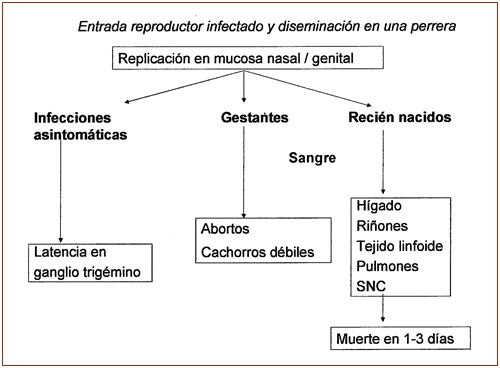
For puppies, the primary route of infection appears to occur during delivery. A few days or hours before whelping, CHV replicates in the bitch's vaginal mucosa, and neonates become infected when passing through the pelvic cavity via the oronasal route. Puppies can also become infected oronasally by contact with carrier adults or other infected puppies.
CHV is shed in nasal secretions for up to 15 days post-infection, in vaginal secretions for up to 16 days, and in preputial secretions for up to 20 days following contamination in males. After CHV-induced abortion, fetuses and fetal membranes constitute the primary source of infection for other dogs. Contaminated puppies shed CHV through saliva, tears, ocular discharge, sputum, urine, and feces.
Like all herpesviruses, CHV infection may remain clinically inapparent, with affected animals becoming carriers. In these cases, external factors such as immunosuppression, stress, corticosteroid therapy, or intercurrent diseases can reactivate the virus, leading to re-shedding via the oronasal or genital route. During latency, there may be no serological immune response, but seroconversion is observed during reactivation. In some bitches, during proestrus, CHV replicates in the vaginal mucosa, causing vesicular lesions in the vulvar and vaginal mucosa. These vesicles, which contain a high CHV load, represent a significant source of contamination for males during mating. These vesicular lesions typically disappear during anestrus.
Prevention
Currently, there is no specific treatment for CHV infection. Some antiviral drugs used to treat human herpes simplex have been tested. 5-Iodo-2-deoxyuridine (Iduridine, Herplex, Emanil) is ineffective. Vidarabine and Acyclovir (Zovirax) can only treat ocular forms. Immunostimulants like poxviruses or bacterial extracts are also ineffective. Therefore, preventive measures remain the only effective approach.
Sanitary Prophylaxis
There are several measures that can be taken to limit the development of herpesvirus in a breeding facility. A logical step would be to eliminate seropositive animals. In reality, this is rarely possible because latent carriers will not be detected through serology. Should a female with a history of herpesvirus be kept or discarded? This is a common question among breeders. Sometimes, after a culling of a litter, subsequent litters are generally normal, so it would be unfortunate to remove the female. However, it must be considered that the upcoming puppies will be latent carriers.
Control of animals before introduction to the breeding facility faces the same limitations as serology, but a PCR test may be performed. Artificial insemination can be used to prevent contamination during mating, effectively protecting the male. As for the female, it is unlikely to be infected through semen, although this has not been conclusively proven. Breeding animals should be carefully examined for genital lesions or respiratory symptoms before mating, and serology can be requested in case of doubt.
In an infected environment, isolating breeders for 8 weeks (4 weeks before and 4 weeks after birth) is essential. Temporarily excluding males showing suspicious lesions from breeding can limit the risk of contamination from male to female.
The herpesvirus’ sensitivity to temperature suggests a simple measure: heat the puppies and maintain their body temperature between 38.5 and 39°C for the first 20 hours post-birth (using heat lamps, electric blankets), while maintaining adequate humidity in the maternity ward to avoid dehydration. Each puppy's rectal temperature should be measured daily to ensure it is neither too high nor too low. Thermoregulation in puppies usually stabilizes between the second and third weeks of life.
Facility hygiene is crucial, as it allows the destruction of a virus particularly sensitive to disinfectants and limits bacterial proliferation that could degrade the animals’ immune defenses.
Medical Prophylaxis
A vaccine against canine herpesvirus (Eurican Herpes 205®) has recently become available. Its mechanism of action involves inducing a strong seroconversion in the pregnant female, with the highest antibody levels at the time of delivery and the following days. These antibodies are transferred to the puppies through colostrum, thus protecting the litter. The health status of the female, whether she is healthy, latently infected, or clinically infected, does not matter, as the goal is to perform passive immunization of the puppies.
The vaccination protocol involves two injections for the female: the first between the start of estrus and mating, and the second 10 days before delivery. After an experimental study, the vaccine's efficacy has been validated in the field.
This vaccine ensures protection for the upcoming litter but does not eliminate healthy carriers. It must be repeated with each pregnancy, and for the veterinarian, it is part of a comprehensive protocol for monitoring the pregnancy from mating or insemination until birth.
Questions about Canine Herpesvirus
-
Can it be transmitted through semen? There is no data supporting this form of transmission. The virus may be transmitted via the lymphoid nodes or papular lesions on the penis mucosa. These lesions contain a large amount of herpesvirus, and since mating is prolonged, mechanical damage to the vaginal mucosa can occur, allowing transmission when the male’s lesions come into contact with the mucosal erosions. If semen is confirmed to be uncontaminated, artificial insemination may be a good preventive measure.
-
Is it true that a female who has had an infected litter will always have stillborns? Generally, abortions or stillbirths caused by CHV trigger an immune response that may protect the female from future intrauterine infections. However, this immune response must be maintained by subsequent contact with infected or carrier animals. If this does not happen, the female will be considered a carrier. The virus may reactivate during the next proestrus or early pregnancy, increasing antibody titers and potentially protecting the female from further intrauterine contamination. If this mechanism does not occur, the female may be susceptible to reinfection, leading to neonatal death or abortion.
-
When should puppies be placed under a heat lamp? As soon as possible after birth, once the mother has consumed the fetal appendages. Puppies should be placed under the heat lamp during the first two weeks of life. The lamp's temperature should be regulated. If the temperature is too high, the puppies will move away from the lamp; if it's too low, they will huddle together, appearing lethargic and depressed. Rectal temperature control is helpful to ensure the lamp’s heat is adequate. Rectal temperature should be between 38.5 and 39°C.
-
Is this method effective? Since there is no curative treatment, this method yields good results if the heat lamp is properly managed.
-
What type of disinfectants should be used? As with humans, silver nitrate can be used for disinfecting the eyes and the oronasal region. However, silver nitrate is irritating to skin and mucous membranes, so it must be diluted properly.
-
In some cases, stillbirths are observed, histological exams show classic intranuclear inclusion bodies, but CHV cannot be isolated. What could be the explanation? In contaminated breeding facilities, an acute CHV outbreak in neonates causes more stillbirths than post-partum deaths. In such cases, fetal contamination occurs several days after birth. Likely, as in equine rhinotracheitis, CHV induces thrombosis in endothelial vessels rather than viremia. In stillborn puppies, necropsy often shows no lesions, and since the virus replicated little or very recently, few intranuclear inclusion bodies are detected. Although virus isolation is often negative, PCR testing may yield positive results. These stillbirths may affect one or two puppies in a litter, and breeders may not be concerned, thinking it’s normal mortality.
-
What is the real incidence of CHV on fertility and fecundity? To date, there is no concrete evidence of CHV’s role in female fertility. However, epidemiological studies show a relationship between infertility and seroprevalence of CHV. Some preliminary studies indicate that in infected females, the number of fetuses at day 25 of pregnancy is normal. However, by the next month, fetal resorption is observed in more than 50% of previous fetuses. Further studies are needed to determine the incidence of CHV in reproductive issues.
-
Why are only some puppies in a litter affected, while others are not? All puppies in a litter are equally susceptible to CHV. Differences may depend on the presence or absence of fetal membranes that protect the fetus during birth. If the membranes are open during birth, ocular-nasal contamination can be massive; however, the fetus may become infected later when still susceptible.
-
Is serology an appropriate technique for diagnosis? If there are many seropositive dogs in a breeding facility, a single serological test cannot diagnose CHV. Samples should be taken with a 2-3 week interval (ideally one sample at birth and another two weeks later). Sometimes, infected females show a physiological increase in antibody titers during proestrus and birth. This seroconversion may not necessarily indicate CHV disease, especially if no other symptoms like neonatal mortality, lesions in puppy necropsies, or CHV isolation are present. More precise serological tests (IgM, ELISA, etc.) are needed to differentiate carriers from sick animals.
-
Can virus transmission be ruled out by negative serology before mating? Yes. The virus is only eliminated by a carrier animal when it exits its latent state and begins to replicate actively, usually during stress, immunosuppression, or other bacterial illnesses, when the animal's defenses are low. For a negative female to contract the virus during mating, the male would have to be actively shedding the virus at that time, typically through respiratory routes. It is unlikely that viral particles are shed in semen, though it is not completely ruled out.
-
Are puppies born to a non-carrier female vaccinated against herpesvirus carriers of the disease? A seronegative female that is vaccinated transfers antibodies to her puppies through colostrum, but if she is not a carrier of the virus, her puppies will not be either.
-
What are the best diagnostic methods for CHV? PCR is the most sensitive and specific test for diagnosing CHV, but it should be conducted by highly specialized laboratories and is not suitable for routine diagnosis. Histological examination of puppy samples is also a reliable method; intranuclear inclusions are specific to CHV. Seroneutralization is a good method for epidemiological studies or diagnosis of suspected animals. Virus isolation is the best method, but sample conditions or low virus levels can result in false negatives.
-
Can we vaccinate males? Although the vaccine is very safe and effective, it is only registered for use in pregnant females. Herpesvirus is usually harmless to adult animals, causing little more than a mild cough. The issue arises when a seronegative female who has never been exposed to the virus becomes infected during pregnancy, potentially leading to embryo resorption, abortion, and neonatal death. Puppies born to such a female have no immunity and acquire antibodies only through maternal colostrum. If the mother had never been exposed to the virus, her colostrum will not provide protection. Therefore, only pregnant females are vaccinated.
-
How does vaccination influence? The passive transfer of maternal antibodies during pregnancy and lactation protects puppies from potential herpesvirus infections after birth. This is the officially registered effect, but it has also been observed that the vaccine reduces other clinical signs associated with herpesvirus by improving fetal size, increasing pregnancy rates, decreasing stillbirths, and increasing weaned animals. This is likely because the vaccination exerts a certain blockage of the herpesvirus in the female if she is infected.
Vaccination: Eurican Herpes 205
What is Eurican Herpes 205?
Eurican Herpes 205 is presented as a powder and diluent for injectable emulsion. Eurican Herpes 205 contains as the active ingredient antigens of canine herpesvirus (strain F205) in doses ranging from 0.3 to 1.75 μg.
Composition for a 1 ml dose:
- Lyophilized: Glycoprotein gB of canine herpesvirus, at least ........ 0.3 micrograms
- Adjuvant: Paraffin..... 224.8 – 244.1 mg
- Aqueous diluent............. 1 ml
Pharmaceutical Form
Emulsion for injection after reconstitution.
Emulsion for injection after reconstitution.
What is Eurican Herpes 205 used for?
Eurican Herpes 205 is indicated for the immunization of female dogs to prevent mortality, clinical signs, and lesions caused by canine herpesvirus infection acquired in the early days of life in puppies. The vaccine induces specific immunity with seroneutralizing antibodies in pregnant females. The puppies are passively immunized by ingesting colostrum, which contains seroneutralizing antibodies.
Eurican Herpes 205 is indicated for the immunization of female dogs to prevent mortality, clinical signs, and lesions caused by canine herpesvirus infection acquired in the early days of life in puppies. The vaccine induces specific immunity with seroneutralizing antibodies in pregnant females. The puppies are passively immunized by ingesting colostrum, which contains seroneutralizing antibodies.
Eurican Herpes 205 is administered through two subcutaneous doses (under the skin) of 1 ml. The first injection is given during the female's estrus or 7-10 days after mating. The second injection is given 1 to 2 weeks before the expected delivery date. Females should be revaccinated during each pregnancy following the same schedule.
How does Eurican Herpes 205 work?
Eurican Herpes 205 contains small amounts of antigens from canine herpesvirus. When injected, this small exposure helps the dog's immune system synthesize antibodies against canine herpesvirus to neutralize it. Once vaccinated, the female passes these antibodies to her puppies through colostrum. When the puppies are later exposed to canine herpesvirus, they will not contract the infection or will experience a much less severe form. Eurican Herpes 205 aims to protect puppies from this infection during the first days of life.
Eurican Herpes 205 contains small amounts of antigens from canine herpesvirus. When injected, this small exposure helps the dog's immune system synthesize antibodies against canine herpesvirus to neutralize it. Once vaccinated, the female passes these antibodies to her puppies through colostrum. When the puppies are later exposed to canine herpesvirus, they will not contract the infection or will experience a much less severe form. Eurican Herpes 205 aims to protect puppies from this infection during the first days of life.
Targeted for: Females
EURICAN HERPES is specifically indicated during pregnancy. No contraindications have been described.
No interactions with other pharmaceutical products are known.
EURICAN HERPES is specifically indicated during pregnancy. No contraindications have been described.
No interactions with other pharmaceutical products are known.
What are the side effects of Eurican Herpes 205?
Injection of Eurican Herpes 205 may cause temporary edema (fluid accumulation beneath the skin) at the injection site in up to 10% of animals. This side effect generally disappears within a week. As with any vaccine, a hypersensitivity reaction may occur. These reactions are rare and will resolve with symptomatic treatment.
Injection of Eurican Herpes 205 may cause temporary edema (fluid accumulation beneath the skin) at the injection site in up to 10% of animals. This side effect generally disappears within a week. As with any vaccine, a hypersensitivity reaction may occur. These reactions are rare and will resolve with symptomatic treatment.
What precautions should be taken by the person administering the medication or coming into contact with the animal?
Eurican Herpes 205 contains mineral oil. Accidental injection may cause acute pain and inflammation, especially if injected into a joint or finger, and in rare cases could even lead to the loss of a finger. In case of accidental self-injection with this product, seek urgent medical advice, even if only a small amount was injected, and bring the package insert with you. If the pain persists for more than 12 hours after medical examination, consult a healthcare provider again.
Eurican Herpes 205 contains mineral oil. Accidental injection may cause acute pain and inflammation, especially if injected into a joint or finger, and in rare cases could even lead to the loss of a finger. In case of accidental self-injection with this product, seek urgent medical advice, even if only a small amount was injected, and bring the package insert with you. If the pain persists for more than 12 hours after medical examination, consult a healthcare provider again.
Overdose
No effects beyond those described as undesirable effects are expected.
No effects beyond those described as undesirable effects are expected.
Special Care
Puppies born to females infected with CHV may be smaller than normal. In infected breeding facilities, puppies born to vaccinated females will have a normal size and weight. This should be taken into account for the birth of toy breeds. The vaccination will have no effect on the adult size of these puppies.
Puppies born to females infected with CHV may be smaller than normal. In infected breeding facilities, puppies born to vaccinated females will have a normal size and weight. This should be taken into account for the birth of toy breeds. The vaccination will have no effect on the adult size of these puppies.
Incompatibilities
In the absence of compatibility studies, EURICAN HERPES should not be mixed with other veterinary products.
In the absence of compatibility studies, EURICAN HERPES should not be mixed with other veterinary products.
Duration
Use immediately after reconstitution.
Use immediately after reconstitution.
Special Storage Precautions
Store at 2 – 8°C, protect from light. Do not freeze.
Store at 2 – 8°C, protect from light. Do not freeze.
Diagnosis
The most reliable diagnosis for canine herpesvirus is the PCR technique.
The most reliable diagnosis for canine herpesvirus is the PCR technique.
In the case of reproductive disorders in a breeding facility, canine herpesvirus should always be investigated due to the severity of its economic impact, which arises from:
- Its prevalence.
- Its effect on fertility and production.
- Its contribution to the development of other pathologies (kennel cough, enteritis, ocular conditions, metritis) that undermine the profitability of the breeding facility.
- Its persistence in the breeding facility once it has infected it.